Hybrid & Remote Work: How Insider and Endpoint Risks Became the New Cybersecurity Challenge
A few years ago, working from home was a luxury. Today, it’s the new normal. Organizations have embraced hybrid and remote work models for flexibility, talent retention, and cost savings, but at the same time, this shift has created a cybersecurity landscape unlike anything we’ve seen before.
Security teams are no longer protecting one office network. They’re protecting hundreds—sometimes thousands—of living rooms, kitchen tables, co-working spaces, and coffee shops. And every laptop, tablet, phone, and app used outside company walls becomes a potential doorway for attackers.
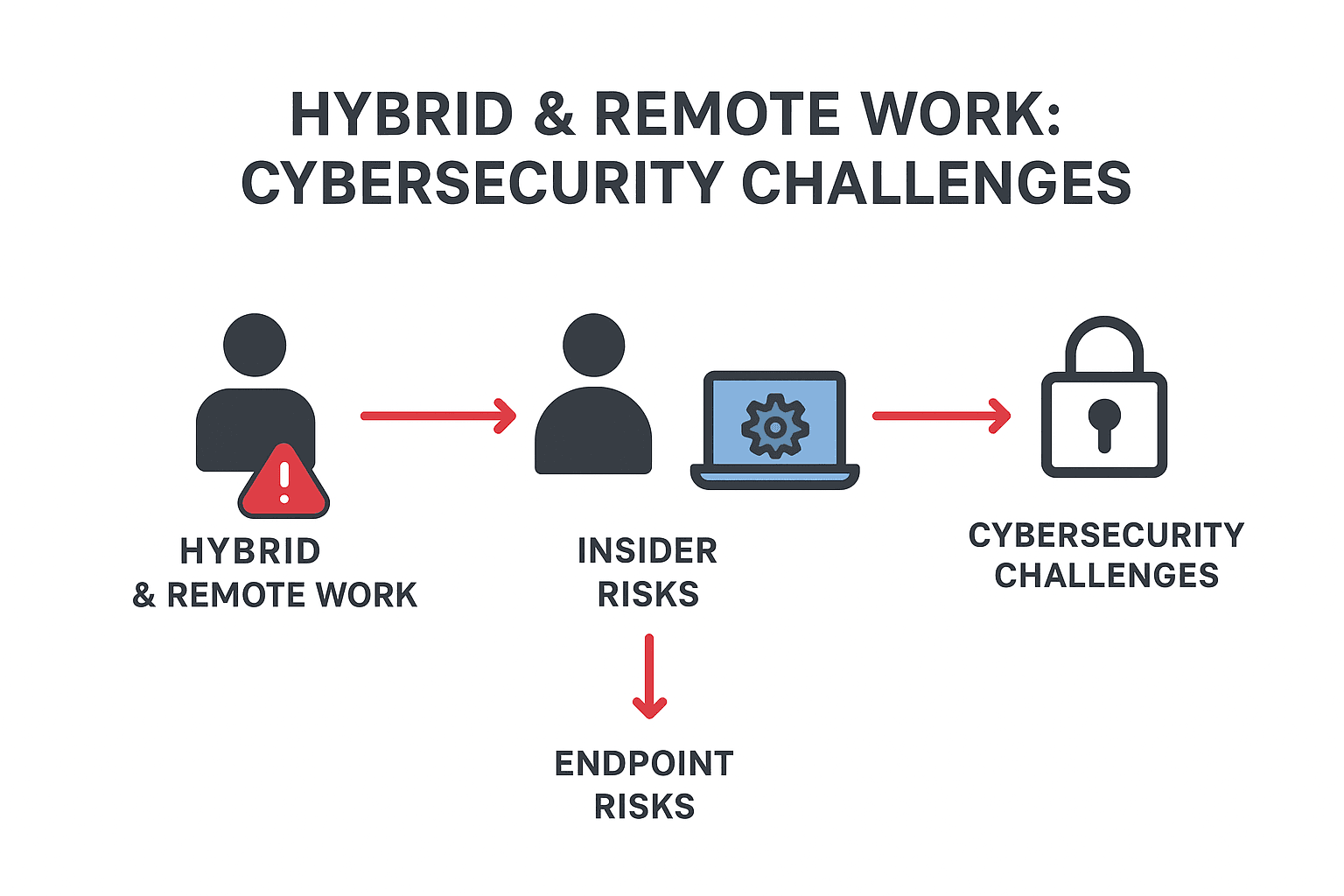
In this new world, insider risk and endpoint threats have become two of the most underestimated yet dangerous vulnerabilities.
The New Reality: Work Is Everywhere, and So Are Threats
Before remote work became popular, organizations had a clear perimeter—the office network. Firewalls, physical security, on-prem servers, and secured Wi-Fi helped create a controlled environment.
But hybrid work changes everything.
Employees now:
Use personal devices mixed with corporate ones
Access sensitive systems from home networks
Share Wi-Fi with family, guests, or neighbors
Store data on cloud apps not approved by IT
Install third-party tools to “make work easier”
Log in from airports, hotels, and public hotspots
This creates a massive attack surface that traditional security tools were never designed to handle.
The Rise of Insider Risk in Hybrid Work
When people hear “insider threat,” they often imagine a malicious employee stealing data. And while that does happen, the more common insider risk is accidental.
Unintentional insider threats include:
Sending files to the wrong email address
Falling for phishing emails
Storing corporate data in personal apps
Forgetting to secure a shared device
Losing a laptop or phone
Using weak or reused passwords
Remote environments make these mistakes easier and more likely.
Malicious insider threats also exist:
Disgruntled employees are stealing data before leaving
Users are misusing privileged access.
Contractors or partners with unnecessary permissions
Individuals are selling. Access to cybercriminals.
Hybrid work gives malicious insiders more privacy and fewer eyes watching.
Endpoint Devices: The Front Line of Cybersecurity
Endpoints are any devices that connect to your business environment, such as:
Laptops
Smartphones
Tablets
Desktops
IoT devices
Personal computers used for work
USB storage devices
Remote-access tools
Every endpoint is a potential target.
The most common endpoint risks include:
Unpatched software
Weak device security settings
Malware and ransomware
Unsecured Wi-Fi networks
Compromised VPN credentials
Outdated antivirus tools
Shadow IT applications
Stolen or lost devices
Attackers love endpoints because they’re easy to exploit and offer direct paths into the company network.
Why Hybrid Work Makes These Risks Worse
1. Home networks are not secure
Most employees don’t change default router passwords.
Many share Wi-Fi with family, neighbors, or smart home devices.
This makes corporate data vulnerable.
2. Personal and work activities blend together
Employees jump between:
Work files
Social media
Personal email
Streaming apps
Online shopping
Gaming
All on the same device.
One wrong click can introduce malware.
3. More endpoints = more complexity
Security teams must manage:
Hundreds of different device models
Different OS versions
Varying levels of security hygiene
It’s a logistical nightmare.
4. Less direct oversight
Managers and IT teams cannot physically observe user behavior.
Risks that were once visible are now invisible.
Common Attack Vectors Targeting Hybrid Workers
Cybercriminals have adapted quickly to remote work environments. Common attack methods include:
Phishing and spear-phishing targeting remote employees
Business email compromise (BEC) scams
Ransomware deployed through remote desktop services
Credential theft via fake VPN portals
Social engineering through messaging apps
Malware embedded in productivity tools
Session hijacking from unsecured networks
Attackers know remote workers are more distracted, more isolated, and more vulnerable.
How Organizations Can Reduce Insider & Endpoint Risk
While hybrid work introduces challenges, it doesn’t have to be a security disaster. The key is adopting modern, proactive cybersecurity strategies.
1. Enforce Strong Identity & Access Management (IAM)
Multi-factor authentication (MFA)
Single sign-on (SSO)
Zero Trust access policies
Least privilege permissions
Identity is the new perimeter.
2. Upgrade Endpoint Protection
Deploy tools such as:
Endpoint Detection & Response (EDR)
Device encryption
Automatic patching
Mobile Device Management (MDM)
These tools help monitor and secure devices 24/7.
3. Promote Cybersecurity Awareness
Training should cover:
Phishing defense
Secure remote work habits
Password hygiene
Data privacy best practices
Humans are your biggest vulnerability, .and your best defense.
4. Segment the Network
Separate work systems from personal devices and home networks as much as possible.
A compromised guest device should not endanger corporate systems.
5. Adopt Zero Trust Architecture
Zero Trust eliminates assumptions.
Every user, device, and application must be continuously verified.
6. Monitor for Insider Threats
Use behavioral analytics to detect:
Unusual file downloads
Unapproved cloud uploads
Off-hours system access
Suspicious privilege escalation
Early detection prevents major damage.
7. Implement Secure Remote Access Tools
VPNs, virtual desktops (VDI), and secure browser isolation reduce exposure.
Hybrid Work Isn’t Going Away. But the Risks Can Be Managed
Remote and hybrid work models bring incredible flexibility and opportunities—but they also introduce a new era of cyber risk. Insider threats and endpoint vulnerabilities can no longer be treated as secondary concerns. They are now at the center of every organization’s security strategy.
The companies that thrive in this new environment will be the ones that:
Protect people as much as devices
Adopt Zero Trust principles
Invest in strong endpoint security
Understand behavior, not just technology
Prepare for insider risk before it becomes a breach
Cybersecurity isn’t about locking employees into the office again—it’s about securing the freedom and flexibility of the modern workplace.