Quantum Computing & Post-Quantum Cryptography: Preparing for the Next Cybersecurity Revolution
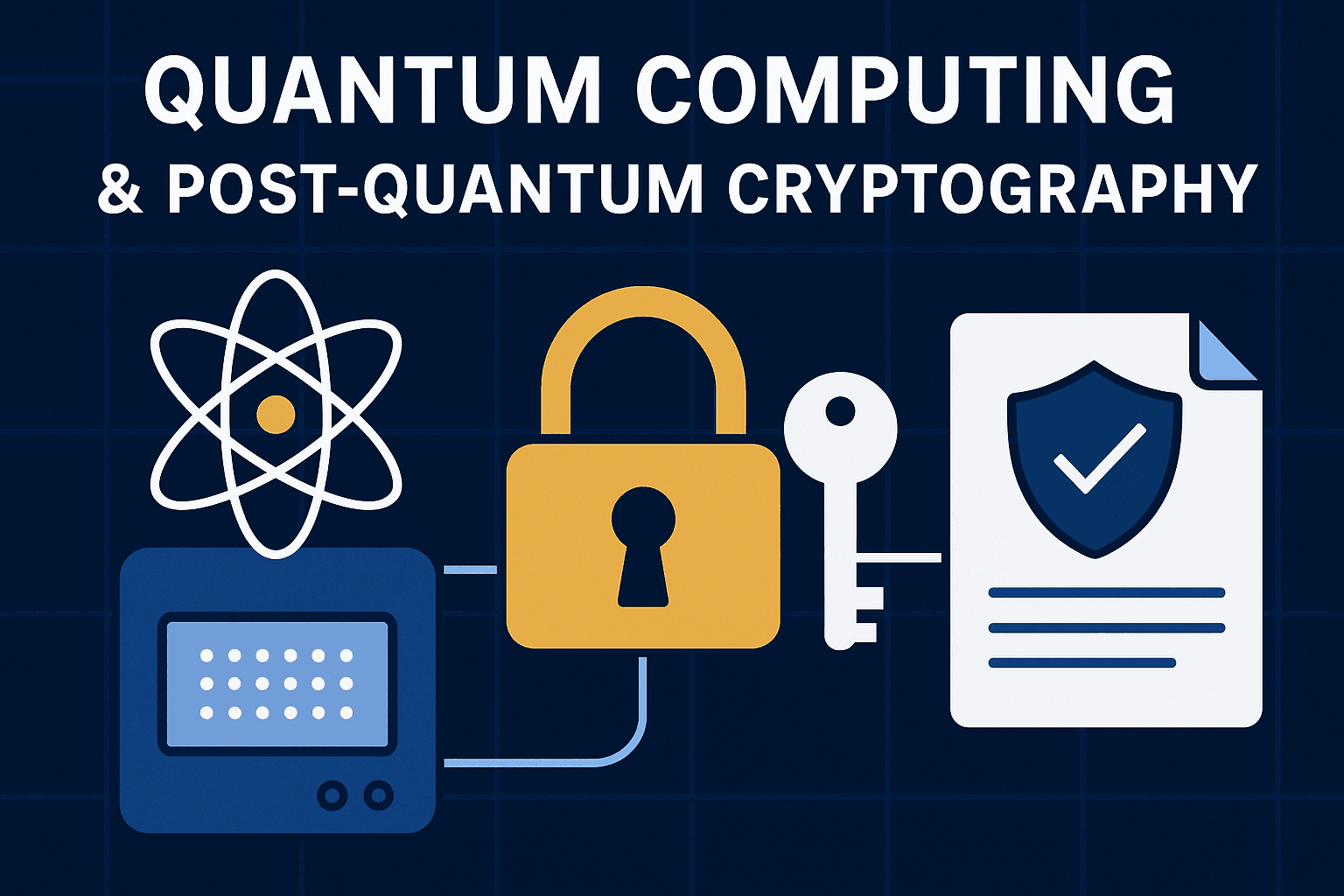
For decades, cybersecurity has relied on mathematical problems that classical computers couldn’t easily solve, such as factoring large numbers or computing discrete logarithms. But the world is changing fast. We’re entering a new era where quantum computers could rewrite the rules of computation and, with it, the rules of security.
_________________________________________________________________________________
Quantum computing is no longer science fiction. Companies, universities, and governments are investing billions into quantum research. And while today’s quantum machines are still early-stage, their potential power is undeniable. One breakthrough could make many of our existing encryption systems obsolete overnight.
__________________________________________________________________________________
This is why Post-Quantum Cryptography (PQC) has become one of the most urgent cybersecurity priorities of the decade.
__________________________________________________________________________________
What Makes Quantum Computers So Different?
Traditional computers process information in bits, either a 0 or a 1.
Quantum computers use qubits, which can be 0, 1, or both at the same time thanks to quantum superposition. This means quantum computers can explore complex possibilities far faster than classical machines.
And here’s the problem:
Many of today’s encryption methods depend on problems that classical computers struggle to solve, but quantum computers won’t.
__________________________________________________________________________________
Why Quantum Computers Threaten Today’s Cryptography
Most modern cybersecurity relies on public-key cryptography,
Including:
- RSA
- ECC (Elliptic Curve Cryptography)
- Diffie–Hellman
- ECDH and ECDSA
These systems protect almost everything online:
- HTTPS websites
- VPNs
- Email encryption
- Digital signatures
- Blockchain transactions
- Secure software updates
- Banking and payment systems
But quantum algorithms, especially Shor’s algorithm, can break the mathematical foundations of RSA and ECC surprisingly fast once powerful quantum computers become available.
⚠ The threat is not only future-based
Attackers today can harvest encrypted data, store it, and decrypt it later once they gain quantum capabilities. This is known as “Store Now, Decrypt Later” (SNDL), one of the biggest emerging risks.
If your data has long-term value (e.g., medical records, biometrics, financial data, state secrets), it could be at risk today even if quantum computers won’t break encryption for years.
What Is Post-Quantum Cryptography (PQC)?
Post-Quantum Cryptography refers to new cryptographic algorithms designed to withstand attacks from quantum computers while still working on classical devices. In 2022 and 2023, the U.S. National Institute of Standards and Technology (NIST) selected several PQC algorithms for future standardization. Leading PQC Algorithms Selected by NIST
- CRYSTALS-Kyber – for key establishment
- CRYSTALS-Dilithium – for digital signatures
- FALCON – for digital signatures (specialized use cases)
- SPHINCS+ – a stateless hash-based signature scheme
These will form the backbone of future-proof encryption.
The transition to PQC has already begun across governments, critical infrastructure, and major tech companies.
Why Organizations Must Start Preparing Now
1. Migration will take years. Crypto transitions aren’t easy.
Many businesses still haven’t entirely replaced outdated algorithms like SHA-1 or TLS 1.0. Switching to quantum-safe cryptography will require:
- Updating protocols
- Replacing libraries
- Re-secure APIs
- Upgrading hardware
- Ensuring backward compatibility
- Training teams
- Passing compliance checks
- Starting early reduces future chaos.
2. Future quantum threats affect today’s sensitive data
If the information you protect has long-term value, it’s already vulnerable.
3. Governments and regulators are moving quickly
PQC readiness is becoming mandatory for:
- Government contractors
- Defense and aerospace organizations
- Financial institutions
- Healthcare and energy providers
- Being ahead of regulations = a strategic advantage.
How to Build a Quantum-Ready Security Strategy
1. Identify where encryption is used in your environment
You can’t protect what you can’t see. Map encryption across:
- Databases
- Cloud systems
- Communications
- VPNs
- Identity solutions
- Backups
- SaaS platforms
- Hardware devices
- Mobile apps
- This is your “crypto inventory.”
✔ 2. Assess which systems need long-term confidentiality
Anything that must remain secure for 10+ years is at risk from SNDL attacks.
✔ 3. Adopt hybrid or quantum-resistant algorithms
Many organizations will first adopt hybrid cryptography, combining classical and quantum-safe algorithms for enhanced security.
✔ 4. Upgrade hardware that can’t handle new algorithms
Some IoT and embedded devices lack the power for future encryption methods.
✔ 5. Test PQC algorithms early
Run pilot programs or test deployments in non-critical systems.
✔ 6. Train your teams
Quantum security affects:
- IT
- Software development
- DevOps
- Security operations
- Compliance
- Risk management
You need organization-wide awareness.
Quantum Computing Will Break Some Things, But It Will Also Enable Incredible Innovation. While quantum computing poses enormous risks, it also promises to revolutionize:
- Drug discovery
- Climate modeling
- Material science
- Logistics optimization
- Artificial intelligence
- Financial modeling
It’s not a threat, it’s a transformation.
Organizations that prepare early will benefit the most from quantum advancements while staying secure.
Final Thoughts: The Future of Cybersecurity Is Quantum-Resistant
Quantum computing isn’t coming; it’s already here, evolving rapidly.
And while we don’t yet have the machines capable of breaking today’s encryption at scale, the race to prepare has already begun.
The real question is not if you should migrate to Post-Quantum Cryptography.
The question is when, and the answer is now.
By understanding PQC, building a migration plan, and staying aligned with emerging standards, organizations can protect their data, ensure business continuity, and lead confidently into the quantum future.